


I do due diligence on dev tools before adding them to my stack. It’s a habit from two years of building Renovate AI on top of AI models. You learn fast that hype and utility are different numbers.
So when I pulled up ecc.tools last week, I started where I always start: the install count. The GitHub repo had 144,000 stars. That’s a crowd-stopper. Then I looked at weekly npm installs: 715.
I sat with that for a second.
144,000 to 715. Star-to-install conversion rate of 0.0005%. Not a typo.
I wasn’t angry. I was fascinated. Because that gap told me something more interesting than “this is hype.” It told me I was looking at two completely different things at once: a distribution play wrapped around a structural bet. And the structural bet might actually be right.
First, respect where it’s due.
The person behind ecc.tools is Affaan Mustafa. Mid-20s, based in SF, crypto background. He launched a $38M FDV token. He livestreamed dev sessions to 70,000 viewers. He won the Anthropic x Forum Ventures hackathon.
He knows how to make things go viral. The X post hit 900K views. Stars spiked. He manufactured the credibility signal. Then he converted that attention into a $19/seat GitHub App that reads your git history and auto-generates custom Claude Code skills, delivered as pull requests. PR-as-demo. Every ship is a marketing moment.
The play is fine. The tells are what’s interesting.
The ecosystem he’s building into is real.
Claude Code is sitting at 42.8M npm downloads per month. 68x growth in 12 months. Anthropic just launched an official plugin directory. Cursor is at $2B ARR, doubled in three months.
Around these platforms, a config layer is forming fast. Addy Osmani from the Chrome team is encoding 20 years of institutional engineering knowledge as Claude Code skills. PRPM is trying to become npm for AI configs. SuperClaude has 22,000 stars running on donations.
Last week, one of my own developers dropped the ECC repo in our team’s WhatsApp group. Unprompted. “Found this repo. Has agentic workflow and skills for all cases. Check it out! Built by Anthropic hackathon winner.” He was genuinely excited about it.
That’s not shade. That’s proof the distribution mechanics work. 144,000 stars creates a gravity that pulls in real engineers who don’t know or care about star-to-install ratios. They see the number, they see the hackathon badge, they share it. The playbook works.
This is the moment before the moment. The part where everyone is building, nobody knows who wins, and the window is real.
I’ve watched this play out in my own stack.
MULTIPLEX is what I call my personal operating system built on Claude Code. 29 skills. Hand-forged, not generated. Each one came from a specific failure or a pattern I kept running into.
One skill knows my B2B deal history. It detects when I’m about to write from DEBTOR position instead of CREDITOR position. That rule came from losing a real deal because I underpriced under pressure. Another skill tracks my energy patterns from Eight Sleep data and flags when I’m scheduling deep work during low-recovery windows. Another one knows the sequence framework I built for managing relationships, because I kept getting burned by giving away too much too fast.
181 generic skills versus 29 that know when I last lost a deal.
ECC builds breadth. I built depth. Neither is wrong. But they’re completely different games. Breadth is trying to become the platform. Depth is trying to compound into one person’s nervous system.
What I’ve found after two years: depth compounds in ways breadth never can. A skill forged from a specific loss doesn’t just remind you of the rule. It understands the context the rule lives in.
That’s not something you generate from a git log.
(If you want to see what a depth-forged skill looks like in practice, the Bouncer is a 146-line security gate I built after months of clicking Yes without reading. And the /loop piece explains how these skills became ambient employees, not just config files.)
The structural pattern underneath all of this is worth naming.
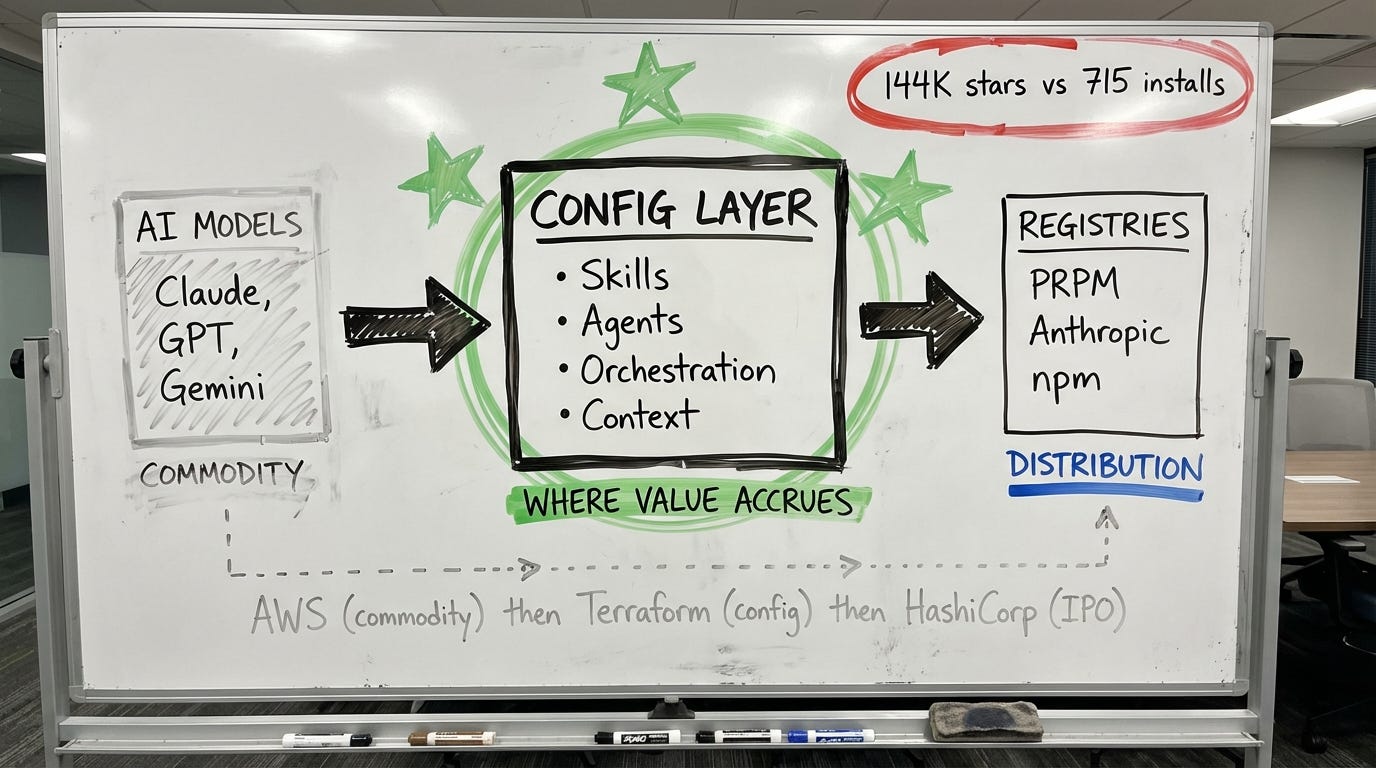
Whoever owns the config layer sets the terms. Same as compute, same as cloud.
The model is becoming a commodity. Claude, GPT, Gemini, whatever ships next quarter. The value layer has moved. It’s sitting in the config, the skills, the orchestration, the context management. The stuff that makes the model behave like your model instead of everyone’s model.
Back to ecc.tools.
715 installs on 144,000 stars is not a business. The “Fortune 500” claim on the site is unverified. About 130 of those 181 skills feel like padding. (Energy procurement? Customs compliance? Inside a dev tool?)
But Affaan understood something real: that Claude Code is becoming a platform, and the first people to publish config packages will have distribution advantages before any registry war is settled. He won a hackathon. He built momentum. He’s 25 and moving fast.
Whether ecc.tools becomes a business or not, the move he made was structurally correct. He saw the land grab early and planted a flag.
What I’m watching now:
The registry wars. PRPM wants to be npm for AI configs. Anthropic wants to own it officially. Cursor has its own ecosystem. The cross-platform portability tools are betting nobody wins and they do.
That bet might be right. Or the winner-take-most dynamics that played out in every other layer of the stack might play out here too.
I don’t know who wins the registry. What I know: a skill that knows when I last lost a deal can’t be generated. It has to be lived.
Extremely valuable; thanks for sharing Sid