

Two days ago I learned about /loop in Claude Code.
By this morning I had rebuilt an entire layer of my personal AI architecture around it. Five distinct operator roles. Different cadences for different jobs. Running whether I’m watching or not.
I want to document this while it’s still bleeding edge. Because I think /loop is the moment the programming language metaphor for Claude Code stops being a metaphor.
I. Assembly
Here’s the thing about working with Claude Code for the past several months: for most of its life, it felt like assembly.
Not in a bad way. Assembly is powerful. You can build anything with it. But every instruction is manual. Every execution is atomic. You write a prompt, you get a response, the session ends. You summon something, it answers, it disappears. The intelligence exists in flashes. Discrete. Ephemeral.
I’ve been building something I call MULTIPLEX on top of Claude Code. A distributed AI cognitive architecture. Multiple avatars (ATLAS, DAEMON, SYNAPSE, FLOW), each with a role, each loaded with the right context for the job. Skills that inject knowledge automatically. Agents that handle specific domains. Hooks that add behavior before and after tool calls. Slash commands that compose all of it into repeatable workflows.
That architecture took months to build. And for all its sophistication, it was still fundamentally assembly.
Every morning: /wake. Every session: summon the right context. Every project: explicitly hand off state. The intelligence was real. But I was the event loop. I was the thing that made it recur.
II. Functions
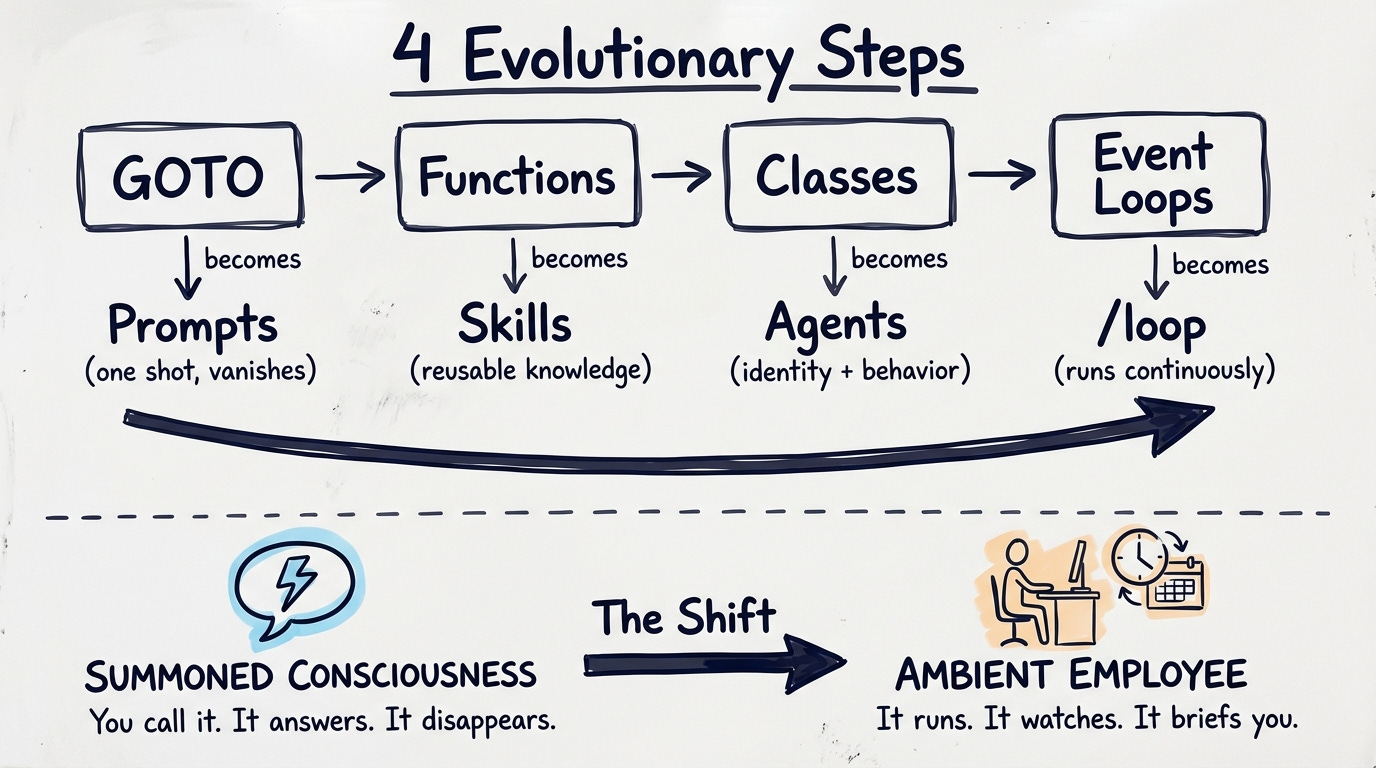
Programming languages evolve through abstraction.
Machine code. Assembly. C. Python. The jump from each level to the next isn’t just convenience. It’s a new way of thinking about what computation is.
I’ve been watching Claude Code evolve the same way in real time.
Skills are functions. Reusable knowledge blocks you can call by name. Before skills, you pasted the same context into every session. After skills, you have a callable library. That’s not a feature. That’s a programming primitive.
Agents are classes. Encapsulated behavior with identity. A browser agent isn’t just “Claude told to use a browser.” It’s a blueprint. It has domain knowledge, verification checklists, platform-specific mechanics. It instantiates with those capabilities. You’re not prompting. You’re instantiating an object.
/loop is an event loop.
And event loops are what separate programs that run from programs that run continuously. Threads. Async execution. Recurring cognition. The thing that makes software feel alive rather than responsive.
When Claude Code shipped /loop, it shipped the primitive that takes AI from “thing you call” to “thing that runs.”
III. Recursion
I didn’t get there immediately.
My first instinct with /loop was the obvious one: set recurring tasks. “Every hour, check my ASO metrics.” Useful. But small. That’s using an event loop to replace a cron job. You can do that. You’d be missing the point.
The question that changed my frame was: “If I had a full-time ASO Atlas, what would he be doing?”
Not “what tasks do I need to automate.” What would a full-time operator actually do all day?
That question turned a feature decision into a staffing decision. And the answer looked completely different.
A watchdog sees snapshots. A full-time operator sees trajectories. A watchdog fires when something crosses a threshold. An operator notices when something has been drifting for three days. Those are not the same job.
So I built two layers.
Layer one: data persistence. Background processes that collect and store, no decisions, no actions. Just accumulation. This is the operator reading reports, taking notes, building context.
Layer two: analysis operators. Five distinct roles, each running at its own cadence. One tracking keyword ranking trajectories over days. One monitoring spend efficiency across campaigns. One watching install patterns for anomalies. Each with its own job, its own cadence, its own scope.
That’s not a cron system. That’s a staff.
IV. Runtime
The phrase I keep coming back to is: summoned consciousness versus ambient employee.
For most of AI’s history with tools like this, you summon. You open a session, you ask, you get. The intelligence exists because you invoked it. It’s a genie. Extraordinarily capable, but only when the lamp is rubbed.
Ambient is different. Ambient means the intelligence is present whether you’re watching or not. It’s tracking things. Building context. Noticing drift. When you do show up, it has longitudinal data, not just a snapshot. It’s been doing the work.
This isn’t just a nicer UX. It’s a different relationship to the system.
I run RenovateAI, an AI-powered home design product. 10M renders shipped. 70K new users a month. Two founders. No VC. I have more data than I have attention to process it. The gap between what’s happening in our ASO metrics and what I know about what’s happening has always been the constraint. Not the data. My attention.
An ambient employee doesn’t fix that by giving me better reports. It fixes it by doing the watching I can’t do. And briefing me on what moved, and why, and what it’s been trending toward. That’s a different answer to the same problem.
V. The Language Is Still Evolving
I want to be honest about where we are.
This feature is two days old. I’ve had my hands on it for forty-eight hours. The architecture I built works, but it’s first-draft. The community hasn’t caught up to what /loop actually is yet. Most people will use it to set reminders. That’s fine. Assembly programmers used to write operating systems in machine code.
The abstractions will compound. /loop today is a raw event loop. Someone will build a higher-level scheduling system on top of it. Then something else on top of that. This is how programming languages evolve.
What I’m confident about: the primitive is real. The shift from “thing you summon” to “thing that runs” is a categorical change in what AI-powered software can be. Not just smarter tools. Not just faster automation. Ambient cognition that’s present in your systems the way a good employee is present. Continuously, contextually, without being explicitly invoked.
That’s AI eating software in the most literal sense. Not replacing the software. Becoming the runtime.
The question I keep sitting with: what does staffing decisions look like when the staff is AI?
Not “what tasks do I automate.” What roles does the system need to function continuously without me? What cadences serve each role? What does the handoff look like when I do show up?
Those are product design questions. They’re also, weirdly, management questions. And I didn’t expect to be asking management questions about my code.
But here we are.
Sid Sarasvati is building Renovate AI and writing about what it’s actually like to use AI to build AI products. MULTIPLEX is his personal cognitive architecture for doing that at speed.
“Bleeding edge” as you rightly said and yes, we are moving towards this provoking management questions.
Well written! 🌊